
In the neurovascular device segment, development is focused on minute, precision devices delivered via micro-catheters. The overarching challenge is to create components that maximize performance within a minimal deliverable profile. That’s where biomaterials come in.

A Growing Need
Most neuro-interventional procedures focus on aneurysm repair. According to the OHSU Brain Institute, nearly 30,000 people suffer a brain aneurysm each year in the United States1; nearly 500,000 deaths occur worldwide each year. Of those who survive, about 66% suffer some permanent neurological deficit.2
Aneurysms are also a major cause of stroke, which is the fourth leading cause of death in the U.S. that affect approximately 750,000 Americans each year. Ischemic stroke, when an artery to the brain is blocked, is by far the most common kind accounting for 87% of all strokes.3
Current solutions for aneurysms, such as coiling or clipping, aren’t always effective and often have adverse side effects. Coiling, for example, involves a lengthy recovery, as well as a high risk of recurrence and perforating the aneurysm. Clipping procedures, on the other hand, are highly invasive with the possibility of serious complications and damage from opening the cranium.
An Alternative Solution
Implantable medical textiles and polymers offer alternative solutions to neurovascular device design that are minimally invasive and provide shape transformation capabilities to allow for low-profile delivery. Specifically, biomedical textiles enable design of solutions for embolic filtration, aneurysm repair, ischemic repair, flow diversion, and various other neurologic disorders.
Textile design engineers have a deep and essential understanding of how various biomedical structures and constituent materials will perform and respond when used in a neurovascular application.
Understanding the performance and biological requirements of a medical device, the desired method of delivery and the materials needed to provide the desired properties are essential to the engineering process and ultimate success in delivering an effective device component.
The Neurovascular Design Toolbox
When selecting biomaterials for neurovascular devices, the immediate performance as well as the future state of the biomedical textile structure must be considered at the beginning of the development process. A strong grasp of raw materials options is critical when selecting the most appropriate biomaterial. 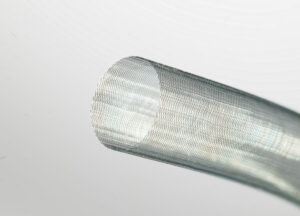
Neurovascular devices frequently utilize metal alloys in their designs. Materials such as nitinol and cobalt-chrome are used extensively due to their stiffness and shape-memory characteristics, which are desired properties in a neurovascular application. Platinum is also used for radiopacity in procedures where a fluoroscope is utilized. Additionally, standard polymers, or resorbable polymers designed to fully resorb over a given time period, can be used. Understanding the advantages and disadvantages of the performance of biomaterials and combinations of these materials is vital to effective structure design and the resulting performance of the device.
Textile and Polymer Manufacturing Options
Aside from material selection, the variety of textile structures and fabric geometries, as well as polymer-based films and coatings, also extend device design possibilities. The selection of biomedical structures must be done thoughtfully in order to address all of the performance and biological variables presented in a critical neurovascular application.
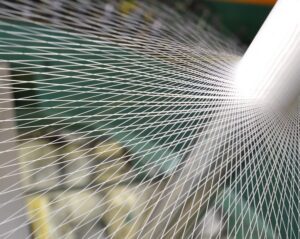
- Braided structures are created by intertwining three or more yarns in a diagonally overlapping pattern. They are often manufactured over mandrels to fix the fabric’s internal diameter and to create near-net shapes and/or geometric foreshortening for catheter-based deliveries. In addition, braided structures can be kink-resistant and easily combined with different materials to enhance specific fabric properties. They are ideally suited for applications that need radial reinforcement and expansion, compaction, flexibility, porosity and highly angulated vasculature such as in neurovascular applications.
An ideal textile engineering partner will have capabilities in high end count braiding and extensive experience in working with extremely fine wire sizes. A cylindrical stent implant is an example of a device created with a braided textile that supports vein function and keeps arteries open. It is also delivered with instrumentation designed for small delivery sites.
- Knitted structures are formed by interlocking loops of yarn or metal in a weft (transverse stitching) or warp (longitudinal stitching) pattern to form flat, broad or tubular structures. Knitted materials are generally porous, highly conformable and elastic with high burst and tensile properties.
- Woven structures are formed by the perpendicular interlacing of two yarns or wires. Woven structures can be created in a multitude of potential shapes including flat, tubular, tapered or near-net shaped fabrics that often are characterized by low porosity (for containment), dimensional stability, high tensile strength, and other unique features such as multilumens, fenestrations and tube-in-tube geometries. They also can be manufactured in low-profile fabrics as thin as 40-50 microns, which is important in minimally invasive applications.
- Film extrusion is a process where raw plastic is melted and formed into a continuous profile to yield a sheet of film (cast film); melted and blown into a lay flat, 2D sheath (tubular extrusion); or when multiple layers of films and other materials are thermally heated to create a single sheet of film (lamination). Extruded films bring a multitude of beneficial properties and characteristics to your medical innovations, including flexibility, durability, smaller profiles, and biocompatibility.
- Dip coating and dip molding can be used to create thin-wall, seamless geometries and conformal coatings for complex components such as stents, balloons, and fabric braids. A scalable and repeatable way to coat materials, dip technology provides excellent properties and protection for devices depending on application and need.
Biomedical Structure Options
Implantable fabrics can be shaped into tubular and multi-lumen structures, tether or suture geometries, or even near-net shapes that include fenestrations or branches. Metallic materials can behave as stent-like structures when oriented in a helical or cylindrical direction, which is often a critical design feature in neurovascular applications. These materials are very effective in providing the necessary geometries compatible with specific application needs while providing the required shape memory abilities. 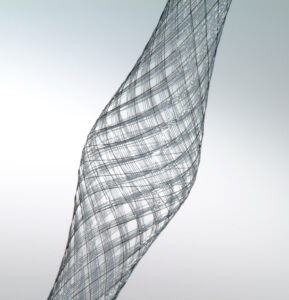
Medical device designers generally have a strong understanding of the neurovascular technology performance requirements of their device but need assistance in understanding how to leverage a biomedical textile or polymer-based solution to meet those requirements. Through communication and engineering collaboration, biomaterials engineers can bridge the gap between the requirements of the neurovascular application and the possibilities offered by implantable medical textiles and polymers
Spark Your Next Innovation with Solesis
With decades of expertise in biomaterials science, Solesis can help you solve your toughest medical device and delivery system challenges with custom polymer and textile solutions. From material selection and early development through scale-up and commercialization, Solesis can help bring your next breakthrough in vascular, general surgery, biopharma, and performance materials to life.
Explore Our Neurovascular Capabilities
Sources
- Brain Aneurysm. OHSU Brain Institute. Web. 9 Dec. 2025
- Statistics and Facts. Brain Aneurysm Foundation. Web. 9 Dec. 2025.
- Stroke Facts. CDC. Web. 9 Dec. 2025.